CI++ MATTING


CI++ Matting from Dural UK makes it easier to install floors of all kinds

CI++ Matting is simple to install in any location over any flooring type
CI++ Matting from Dural UK serves to make it easier to install floors of all kinds, even on difficult surfaces like old screed or wood, and they also protect the new floor covering from moisture seeping from below as well as preventing stretching or cracks.The mats are made of yellow polythene with a grid of texturing nodules and a supporting polypropylene fleece layer on the back. This combination means the matting is resistant to most chemicals.
CI++ matting is a product designed to alleviate stress caused by lateral movement within substrates normally viewed as unstable. These would include:
Green screeds (shrinkage still occurring)Fresh power floated concrete floors
Timber based substrate such as ChipboardFloorboards, Particleboard and MDF
Metal surfacesAsphalt
It is also suitable for use with all under floor heating systems
Applying a rigid floor covering to such surfaces would normally be difficult. CI++ matting is a simple fixing method to achieve satisfactory results with the minimum of cost and labour. The lateral movement of such surfaces would normally cause tiles to debond or crack.
There are infinite combinations of substrates and variations in ceramics, slates, marbles and other surfaces which could be used on a project so it is impossible to provide a definitive guarantee for any specific project. However if care is taken to ensure that any vertical flexing of the substrate is removed then a very high chance of success is likely. Dural is prepared to guarantee the performance of the product that we reccommend. This would always be subject to the removal of vertical flex and that all work was carried out under our fixing instructions and with due professional care and diligence. In short the product does not work miracles it can only function correctly where it has been fixed in the correct manner.
KEY POINTS
One of the prime purposes of CI++ matting is to absorb stress within tiled installations by absorbing lateral movements that occur in substrates. BUT! At the junction of the two substrates vertical movement can likely occur. Even the smallest amount can cause tiles, (especially those of natural material), to crack at this point. CI++ matting cannot absorb this movement. Even over boarding both surfaces would not be guaranteed to remove this risk. LARGER AREAS SUMMARY
CI++ MATTING & MOVEMENT JOINTS
The decoupling action of the product is exceptionally effective in dealing with this type of movement, even for wooden substrates where the movement can be viewed as cyclical. Humidity and temperature can lead to repeated expansion and contraction of this difficult surface. However where surfaces move vertically, CI++ matting offers no protection. This is best understood anecdotally.
For example, a new extension to a building is undertaken where the tiled surface is required to run across both the old and new surface. In these circumstances the existing floor will probably be well established and stable. The new floor in the extension could be subject to settlement or general movement.
Whatever the base material used to form the substrate in both floors CI++ matting will absorb any stress caused by horizontal movement.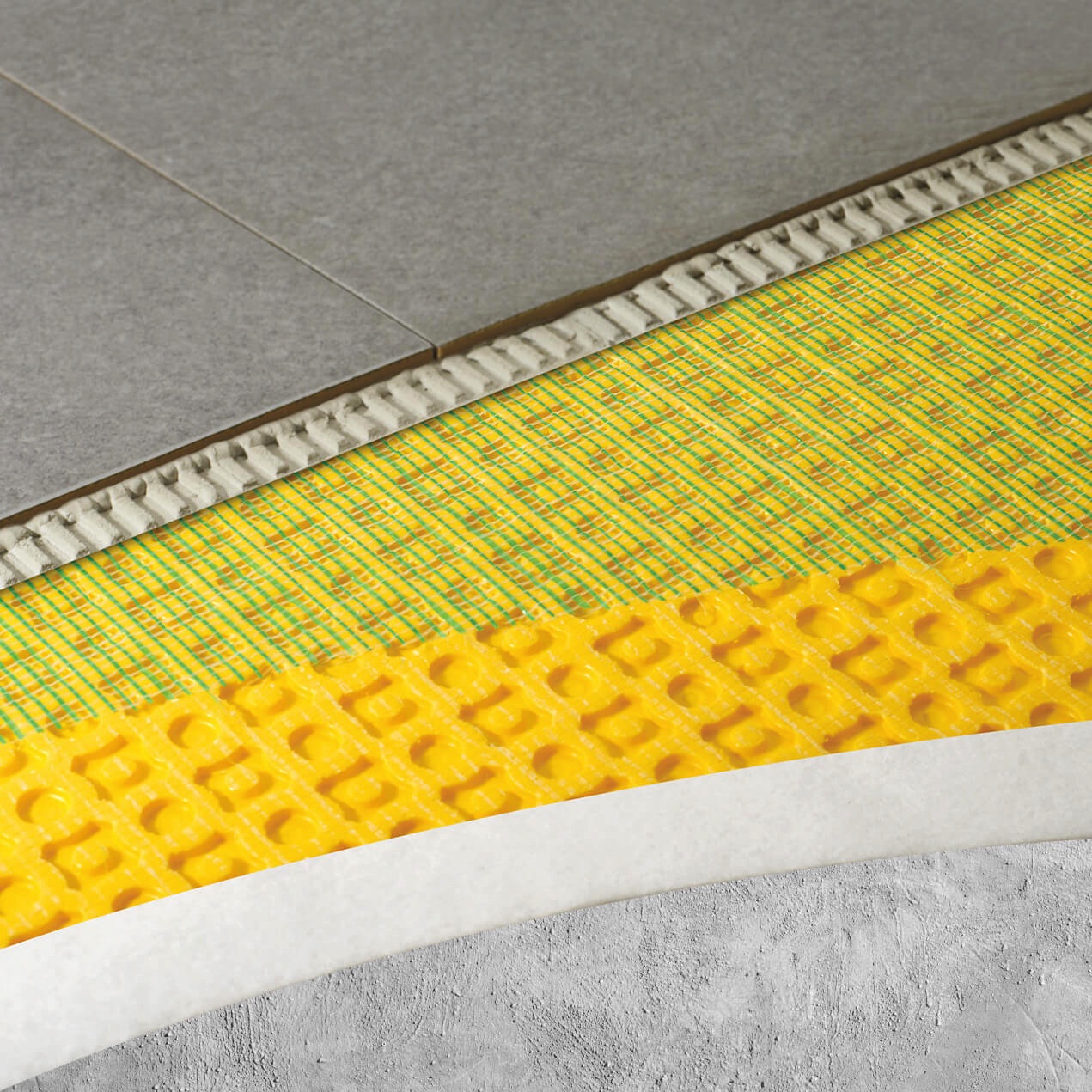
The only safe answer to this situation is to fix a movement joint exactly at the junction point of the two substrates and carry it through the tiled surface as recommended by BS 5385. Some clients find the idea of a movement joint at this point less than ideal. We can offer help to reduce impact by providing a colour co ordinated movement joint to match either the tiled surface or grout lines. (Minimum order 1 x 2.5mtr length). If this is unacceptable, the client must be advised, (preferably in writing), that no responsibility will be accepted if subsequent cracking occurs.